Thursday, February 9, 2012


Monday, February 6, 2012
Celebration
Well, I thought about it. And I decided that, instead of using prizes for rewarding progress, what seems right to me is celebration.
What makes celebration different from prizes or even inherent rewards is it's essential communal and relational nature. It is further distinguished in being an activity performed in harmony rather than an object (or pronouncement) that is bestowed upon one person by another. In the acting together, we honor and affirm what we celebrate and experience joy communally. It is in this same sense that we "celebrate" the liturgy.
Recognizing that a kindergartener may need more proximate goals and celebrations than that far off "someday" when she can read any book in the library all by herself, I started looking for some smaller milestones we could celebrate together. Accordingly, this past Saturday, I took Katherine for a mom-and-daughter date to celebrate her successfully reaching the "half-way through Kindergarten" mark.
We walked down to the neighborhood nail spa together and got our nails done. While we were waiting for the polish to dry, we dove into Tales of the Kingdom. (The illustrations in the original hardcover printing had piqued her interest earlier when she found the book on her crowded bookshelf filled with both new and hand-me-down treasures.) Katherine seemed a little distracted by all that was going on in the salon, but she was still listening. When we left, she immediately started asking me to tell her more about the characters in the book. We tried stopping in for tea at the nearby bakery so we could continue reading, but the place was closed for refurbishment. After some discussion, we settled on Rubio's. We read until we were hungry for lunch and then enjoyed our tacos and read some more. Katherine was riveted by the Tales (and I cannot recommend them enough).

When we were home again and ready for naps, I prayed over Katherine aloud and thanked God for bringing her into my life and for helping her work diligently to finish the first half of Kindergarten. Then, as I tucked her into bed, I performed my familiar litany of affection over her with kisses and hugs: "I am so glad you were born to me. I am so glad I get to know you and be with you everyday. I love you so much. You are my special bonny, and I am so glad you are in my life." I could tell that she felt peaceful and loved and happy all the rest of the day.
Is all this attention and affirmation really different from praise? Perhaps it is merely a particular kind of praise, the kind of praise I can embrace because I find it to be authentic and loving and not manipulative. It's the kind of praise one would be able to freely give to a peer or even a superior without fear of being pedantic or condescending. It's a praise that is actively with the other, that honors and affirms the other, a praise that is inseparable from gratitude and festivity. It is less like the praise we give a dog in training and more like the praise we give our Lord. It is a kind of praise that gives blessing to both the one being praised and the one praising. Like participation in the liturgy, these special mommy moments are gifts, foretastes of heaven given to Marthas who finally leave the kitchen and sit down to drink in the little Christs in their lives.
What makes celebration different from prizes or even inherent rewards is it's essential communal and relational nature. It is further distinguished in being an activity performed in harmony rather than an object (or pronouncement) that is bestowed upon one person by another. In the acting together, we honor and affirm what we celebrate and experience joy communally. It is in this same sense that we "celebrate" the liturgy.
Recognizing that a kindergartener may need more proximate goals and celebrations than that far off "someday" when she can read any book in the library all by herself, I started looking for some smaller milestones we could celebrate together. Accordingly, this past Saturday, I took Katherine for a mom-and-daughter date to celebrate her successfully reaching the "half-way through Kindergarten" mark.
We walked down to the neighborhood nail spa together and got our nails done. While we were waiting for the polish to dry, we dove into Tales of the Kingdom. (The illustrations in the original hardcover printing had piqued her interest earlier when she found the book on her crowded bookshelf filled with both new and hand-me-down treasures.) Katherine seemed a little distracted by all that was going on in the salon, but she was still listening. When we left, she immediately started asking me to tell her more about the characters in the book. We tried stopping in for tea at the nearby bakery so we could continue reading, but the place was closed for refurbishment. After some discussion, we settled on Rubio's. We read until we were hungry for lunch and then enjoyed our tacos and read some more. Katherine was riveted by the Tales (and I cannot recommend them enough).
When we were home again and ready for naps, I prayed over Katherine aloud and thanked God for bringing her into my life and for helping her work diligently to finish the first half of Kindergarten. Then, as I tucked her into bed, I performed my familiar litany of affection over her with kisses and hugs: "I am so glad you were born to me. I am so glad I get to know you and be with you everyday. I love you so much. You are my special bonny, and I am so glad you are in my life." I could tell that she felt peaceful and loved and happy all the rest of the day.
Is all this attention and affirmation really different from praise? Perhaps it is merely a particular kind of praise, the kind of praise I can embrace because I find it to be authentic and loving and not manipulative. It's the kind of praise one would be able to freely give to a peer or even a superior without fear of being pedantic or condescending. It's a praise that is actively with the other, that honors and affirms the other, a praise that is inseparable from gratitude and festivity. It is less like the praise we give a dog in training and more like the praise we give our Lord. It is a kind of praise that gives blessing to both the one being praised and the one praising. Like participation in the liturgy, these special mommy moments are gifts, foretastes of heaven given to Marthas who finally leave the kitchen and sit down to drink in the little Christs in their lives.
Monday, January 23, 2012
Prizes, Praises, Gifts, and Inherent Rewards
Today my daughter was a bit tired with her school work and was having trouble staying focused and motivated. She asked me if I would please start giving her prizes ("like maybe stickers or something") for doing a good job with her assignments.
"Hmm. I'll have to think about that, Katherine," I told her.
I understand that staying focused on penmanship and spelling seat work can be very difficult, especially when you're only five years old, and I understand that, at any age, it helps to reward and motivate ourselves along the way as we take small steps toward a larger goal. At the same time, I really don't want to give the message that my children's behavior earns them petty prizes. I don't want Katherine to do "a good job" in order to get some unrelated trinket; I want her to see that working hard is it's own reward and has inherent benefits.
Although well-intentioned, the instructors Katherine has interacted with in community classes over the years have perpetuated this idea in her mind that she should perform in order to receive evaluative praise ("good job!") and prizes such as hand stamps and stickers ("because you did such a good job today!"). The fact that, at the tender age of five, Katherine already associates her performance with behavioristic evaluations and prizes saddens me, even if it does not surprise me. I slip into this kind of evaluation and behaviorism, too, even though I loathe it in principle.
I run out of attention and energy and find myself blurting out assessments such as "Nice work, Katherine!" when what I really mean is "I am happy for you! I'm glad you accomplished what you were trying to do!" or "Thank you for doing what I asked you to do. I really like it when you obey right away/help me out/are kind to your brother/work diligently at your school work/etc."
Although we all mean well when we say "Good job!" or "Nice work!", at the end of the day, we're giving an evaluation, and, even though it's positive, it's still an assessment, a judgement, a "you statement" at the core. We are communicating the message that our children need us to tell them whether or not their performance measures up. And we are, in the same way, habituating them to distrust their own ability to assess their performance and to rely instead on other people for their self-worth and self-image. We are talking over their own intuitive knowledge and drowning out the still, small voice of God within them, as if they could not hear him except through us.
Of course God does call parents to communicate his truth to their children, but I am not talking here about passing on the history of salvation, the doctrines of the creeds, moral principals, or other timeless truths. I also do not mean to imply that we should withhold our warmth, love, acceptance, or affection from our children. I am calling attention to the times when we evaluate our children's performance instead of teaching them to listen to God's Spirit in their hearts and to act out of awareness of and love for God and others.
When we use "I statements," instead of evaluations, however, we communicate information to our children that they don't already have within them, information that can help them become more compassionate and relational and can equip them to make loving choices. We share our feelings, our values, and our preferences: "I am so happy to see you and your brother working together as a team." "It's important to me to have a tidy home." "I like it when you help me set the table." We express our gratitude: "Thank you so much for helping me with the laundry! I really appreciate it!"
While I empathized with Katherine's desire and told her that I do love to give her fun things like stickers, I made a distinction between gifts and rewards. I told her that I give her things like stickers or treats for fun and just because I love her; she doesn't have to do anything to get those kind of things from me because they are gifts. Then I asked her why we work hard to learn our spelling and penmanship, even when we feel tired or bored. We talked about how awesome it will be when she can pick up any book in the library and read it all by herself, when she can write letters to friends and write down whatever she wants to say all by herself. Reading and writing are the inherent rewards of learning spelling words and penmanship. We talked about how it takes a lot of hard work over a lot of days and weeks to get there, but how worth it it all will be. Then I thanked her for working hard and told her I love her.
So, today's most important homeschool lesson turned out to be less about why we don't spell "was" as "wuz," and more about why we keep at our work even when it's difficult: We do it for the long-term, inherent rewards. We get fun stuff, too, but not because of our performance. And most importantly, we are loved all the time and that, thank God, has nothing to do with anything we do.
For more insight into how evaluative praise effects children, see Po Bronson's 2007 article in New York Magazine, "How Not to Talk to Your Kids: the Inverse Power of Praise."
.
"Hmm. I'll have to think about that, Katherine," I told her.
I understand that staying focused on penmanship and spelling seat work can be very difficult, especially when you're only five years old, and I understand that, at any age, it helps to reward and motivate ourselves along the way as we take small steps toward a larger goal. At the same time, I really don't want to give the message that my children's behavior earns them petty prizes. I don't want Katherine to do "a good job" in order to get some unrelated trinket; I want her to see that working hard is it's own reward and has inherent benefits.
Although well-intentioned, the instructors Katherine has interacted with in community classes over the years have perpetuated this idea in her mind that she should perform in order to receive evaluative praise ("good job!") and prizes such as hand stamps and stickers ("because you did such a good job today!"). The fact that, at the tender age of five, Katherine already associates her performance with behavioristic evaluations and prizes saddens me, even if it does not surprise me. I slip into this kind of evaluation and behaviorism, too, even though I loathe it in principle.
I run out of attention and energy and find myself blurting out assessments such as "Nice work, Katherine!" when what I really mean is "I am happy for you! I'm glad you accomplished what you were trying to do!" or "Thank you for doing what I asked you to do. I really like it when you obey right away/help me out/are kind to your brother/work diligently at your school work/etc."
Although we all mean well when we say "Good job!" or "Nice work!", at the end of the day, we're giving an evaluation, and, even though it's positive, it's still an assessment, a judgement, a "you statement" at the core. We are communicating the message that our children need us to tell them whether or not their performance measures up. And we are, in the same way, habituating them to distrust their own ability to assess their performance and to rely instead on other people for their self-worth and self-image. We are talking over their own intuitive knowledge and drowning out the still, small voice of God within them, as if they could not hear him except through us.
Of course God does call parents to communicate his truth to their children, but I am not talking here about passing on the history of salvation, the doctrines of the creeds, moral principals, or other timeless truths. I also do not mean to imply that we should withhold our warmth, love, acceptance, or affection from our children. I am calling attention to the times when we evaluate our children's performance instead of teaching them to listen to God's Spirit in their hearts and to act out of awareness of and love for God and others.
When we use "I statements," instead of evaluations, however, we communicate information to our children that they don't already have within them, information that can help them become more compassionate and relational and can equip them to make loving choices. We share our feelings, our values, and our preferences: "I am so happy to see you and your brother working together as a team." "It's important to me to have a tidy home." "I like it when you help me set the table." We express our gratitude: "Thank you so much for helping me with the laundry! I really appreciate it!"
While I empathized with Katherine's desire and told her that I do love to give her fun things like stickers, I made a distinction between gifts and rewards. I told her that I give her things like stickers or treats for fun and just because I love her; she doesn't have to do anything to get those kind of things from me because they are gifts. Then I asked her why we work hard to learn our spelling and penmanship, even when we feel tired or bored. We talked about how awesome it will be when she can pick up any book in the library and read it all by herself, when she can write letters to friends and write down whatever she wants to say all by herself. Reading and writing are the inherent rewards of learning spelling words and penmanship. We talked about how it takes a lot of hard work over a lot of days and weeks to get there, but how worth it it all will be. Then I thanked her for working hard and told her I love her.
So, today's most important homeschool lesson turned out to be less about why we don't spell "was" as "wuz," and more about why we keep at our work even when it's difficult: We do it for the long-term, inherent rewards. We get fun stuff, too, but not because of our performance. And most importantly, we are loved all the time and that, thank God, has nothing to do with anything we do.
For more insight into how evaluative praise effects children, see Po Bronson's 2007 article in New York Magazine, "How Not to Talk to Your Kids: the Inverse Power of Praise."
.
Thursday, November 10, 2011
Friday, October 7, 2011
Keeping it Kinetic
I've discovered an essential key to keeping our homeschooling efforts from languishing in static boredom and ineffectiveness. Without it, Katherine would tire and lose focus and motivation. Without it, Jude would go ballistic sabotaging all our seat work. And it's as simple as "Pat-a-cake, pat-a-cake."
After morning prayers, before we begin any other subjects or seat work, we sing one or two songs with movement to get energized, focused, and ready to go. We sing and move to another song or two after each 15 to 30 minutes of seat-work. This allows me to "feed the meter" on Jude's attention and active-toddler needs and also allows Katherine to get out her wiggles and mix things up. If I skip the music and movement, getting Katherine to engage in seat-work (a.k.a. penmanship, spelling, and reading) feels like pulling teeth. With the kinetic breaks, she is a whole lot more cooperative.
And, well, music and movement time is just plan fun, not to mention educational in its own right! Some of the songs also really get the heart pumping for a healthy mini-workout.
Some of our favorite songs with movement so far are the following:
And sometimes we just play a fast song on the computer-stereo and dance like crazy people around the apartment. A kinetic round of Simon Says also works.
What are some other good movement and music songs? Which ones do you like to sing with your little people? Do share.
After morning prayers, before we begin any other subjects or seat work, we sing one or two songs with movement to get energized, focused, and ready to go. We sing and move to another song or two after each 15 to 30 minutes of seat-work. This allows me to "feed the meter" on Jude's attention and active-toddler needs and also allows Katherine to get out her wiggles and mix things up. If I skip the music and movement, getting Katherine to engage in seat-work (a.k.a. penmanship, spelling, and reading) feels like pulling teeth. With the kinetic breaks, she is a whole lot more cooperative.
And, well, music and movement time is just plan fun, not to mention educational in its own right! Some of the songs also really get the heart pumping for a healthy mini-workout.
Some of our favorite songs with movement so far are the following:
- I'm a Little Tea Pot
- Pat-a-Cake, Pat-a-Cake, Baker's Man
- Head and Shoulders
- Five Little Monkeys Jumping on the Bed (We actually jump on the bed for this one, which makes it a favorite of favorites.)
- Open and Shut Them
- Ring-a-Ring-a-Rosie
- Father Abraham
- I'm in the Lord's Army
- See How I'm Jumping
- If You're Happy and You Know It
- Praise Ye the Lord, Alleluia (We crouch down and then pop up like a Jack-in-the-box for one or other of the refrains.)
And sometimes we just play a fast song on the computer-stereo and dance like crazy people around the apartment. A kinetic round of Simon Says also works.
What are some other good movement and music songs? Which ones do you like to sing with your little people? Do share.
Saturday, September 17, 2011
How Education Paves the Road to Faith
The Bible tells us that what is required to enter the Kingdom of God is the simple faith of a child. So why should Christians pursue an academic education?
Because such an education is, in an important way, a means for us to come to have the simple faith of a child, says Jim Kushiner, the executive director of the Fellowship of St. James, publisher of Touchstone and Salvo magazines.
In the last five to ten minutes of his interview from last November on Ancient Faith Radio's "In the World" podcast, Kushiner explains his dynamic view of a Christian education. Because the culture has perceptibly and imperceptibly pervaded our habits of thinking, feeling, and acting, we need a thorough education to rid ourselves of false beliefs and come to knowledge of the truth.
An integrated education in philosophy, theology, the humanities, and the sciences, "gives people the tools to reclaim the Christian mind," to "detoxify and cleanse the mind," to "see the world through the eyes of Christ" rather than be "conformed to the world's mind." An education also allows us to "harvest the fruit" of the riches of the Christian tradition, the Fathers, the liturgy, and the hymnography of the Church. And because the world is created good, it is worthy of study and leads to greater knowledge of the Creator. Studying the glories of creation properly leads to a deep sense of wonder, "the workshop of worship."
This dynamic pairing of wonder and piety, prayer and scholarship, love and knowledge, this is the goal I seek as I educate my children (and continue to re-educate myself in the process).
Because such an education is, in an important way, a means for us to come to have the simple faith of a child, says Jim Kushiner, the executive director of the Fellowship of St. James, publisher of Touchstone and Salvo magazines.
In the last five to ten minutes of his interview from last November on Ancient Faith Radio's "In the World" podcast, Kushiner explains his dynamic view of a Christian education. Because the culture has perceptibly and imperceptibly pervaded our habits of thinking, feeling, and acting, we need a thorough education to rid ourselves of false beliefs and come to knowledge of the truth.
An integrated education in philosophy, theology, the humanities, and the sciences, "gives people the tools to reclaim the Christian mind," to "detoxify and cleanse the mind," to "see the world through the eyes of Christ" rather than be "conformed to the world's mind." An education also allows us to "harvest the fruit" of the riches of the Christian tradition, the Fathers, the liturgy, and the hymnography of the Church. And because the world is created good, it is worthy of study and leads to greater knowledge of the Creator. Studying the glories of creation properly leads to a deep sense of wonder, "the workshop of worship."
This dynamic pairing of wonder and piety, prayer and scholarship, love and knowledge, this is the goal I seek as I educate my children (and continue to re-educate myself in the process).
Tuesday, September 13, 2011
Penmanship Lifesavers
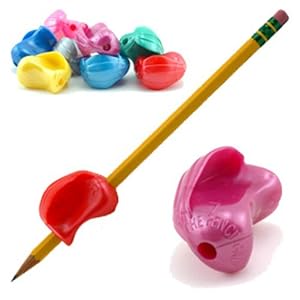
 out of my homeschool supply kit saved our penmanship lesson attempts in our first week of Kindergarten instruction.
The Pencil Grip Crossover
is THE BEST pencil grip out there, as far as I can tell. Until I got ours out for my daughter, she was unable to keep her three writing fingers in the correct position and kept pinching and crossing her top two fingers—thumb and pointer—above the pen rather than keeping them on the sides of the pen.I had thought that the triangle-shaped pen we were using might provide sufficient guidance and support on its own, but I was mistaken, at least for little four-year-old hands. The Pencil Grip Crossover has a special wall and cover that makes it impossible to cross or pinch the top two fingers. Older kids starting penmanship later might not need it, but I'm loving how these grips give my daughter the ability to let her fingers keep better pace with her aspirations.
Subscribe to:
Posts (Atom)