Reflections on the various dimensions of feminine vocation from liturgical homemaking and child rearing to education and the spiritual life.

Friday, October 12, 2012

Raising Boys by the Boy Code?

William Pollack, Harvard psychologist and author of Real Boys , has spent twenty years studying boys in our culture. He points out that, at birth, male infants actually seem to be more emotionally expressive than females. But by elementary school, most of that is gone, thanks to a gender straitjacket enforced by what he calls the Boy Code. According to the code, boys and men must not, above all, express their feelings. This rule constrains not only boys, "but everyone else, reducing us all as human beings, and eventually making us strangers to ourselves and to one another."*
Some sixty-five years before Pollack published his New York Times bestseller, C. S. Lewis suggested a similar conviction that it is emotion and sentiment that makes us human. In the Platonic tripartite psychology of head-chest-belly, it is by the middle element, the chest, the seat of emotion and sentiment, "that man is man: for by his intellect he is mere spirit and by his appetite mere animal" (The Abolition of Man , p. 25). An education or upbringing that teaches boys to debunk or stifle their feelings produces, in Lewis's words, "Men without Chests": 
It is not excess of thought but defect of fertile and generous emotion that marks them out. [. . .] And all the time—such is the tragi-comedy of our situation—we continue to clamour for those very qualities we are rendering impossible. You can hardly open a periodical without coming across the statement that what our civilization needs is more 'drive,' or dynamism, or self-sacrifice, or 'creativity.' In a sort of ghastly simplicity we remove the organ and demand the function. We make men without chests and expect of them virtue and enterprise. We laugh at honour and are shocked to find traitors in our midst. We castrate and bid the geldings be fruitful. (25-26)
With his usual insight, Lewis calls our attention to an amazing truth about human nature. However, I'm not sure he goes far enough in his writings. While he urges us to preserve the child's seat of emotion, he wants to see that emotion is properly trained into "stable sentiments" that will lead the child to respond to their experiences with habituated virtue. This is well and good. In fact, Lewis supplies what Pollack may lack in this regard. 

At the same time, Pollack—and other contemporary voices proclaiming with him a similar message—may supply a consideration that Lewis omits, namely the human need to express, to hear, and to accept the immediate, raw, and untrained feelings of ourselves and others with empathy, compassion, and sensitivity regardless of whether the expressed feelings conform or no to any approved sentiments.

To illustrate the passing on of trained sentiment, Lewis gives the example of the Roman father passing on to his son his own deeply-felt conviction—"Dulce et decorum est . . ."—that it is sweet and right to die for one's country. 

Pollack and others point out the complementary truth that it is also humane to express fear and sadness without shame and to nurture and comfort others when they express those natural human feelings.

Elaine Aron is another of the contemporary voices calling for a more humane view of the sexes. She warns of the unhelpfulness of stereotypes and generalities like the often heard "When women have problems, they just want to be listened to, but men want to give and get solutions." She argues instead that "We all need to express our feelings and find solutions to problems," and she cites research that "shows with perfect consistency that people in relationships are happier when women and men behave in what in the past has been seen as a traditionally 'feminine' way—that is, warm, nurturing, emotionally expressive, and eager to discuss the relationship. [. . .] what's called 'feminine' is simply 'normal human.' Fortunately, most men do behave that way too—contrary to stereotypes."*

By relating an example from his own childhood, San Francisco psychotherapist, Spencer Koffman, paints a vivid picture of how the Boy Code stunts the basic human need to express and accept emotion:
Boys are enlisted into "gender bootcamp" at a very early age, where they are taught to be good Warrior/Kings. One of my earliest memories of this indoctrination comes from first grade. I fell off the jungle-gym. I wasn't seriously hurt, but the shock of the fall caused me to cry. The uniform reaction from every boy and teacher was not to console me, but to point out that boys do not cry. That was the first and last time that I cried in school. I was in training to become "a little soldier."*
As I face the daunting challenge of raising a boy, I pause to ask myself, How can I equip my son to become a soldier against injustice, a ruler of himself, and a comforter of many, one who is not afraid to cry, to grieve, to rejoice, to engage, and to love with a full-orbed expression of his God-created humanity?


*Quotations from Elaine Aron's The Highly Sensitive Person in Love, a book about which I have several caveats but still find to have helpful insights.

Saturday, October 6, 2012

"Start Here" for Homeschool Curriculum

Update: In case you haven't heard, Cathy Duffy released her revised and updated 101 Top Picks for Homeschool Curriculum in July.

Original 3/21/12 post:
For those considering homeschooling, I highly recommend 100 Top Picks for Homeschool Curriculum as an excellent starting place. Although her curriculum reviews and "top picks" are helpful, the best part of the book is definitely the first series of chapters wherein she overviews the various common approaches to homeschooling and how to identify the approach(es) that best suit the vision, priorities, and individual needs of your particular family. She takes out a lot of the guess work by providing self-assessment tools to help you identify your best matches. Then she identifies curriculum that would deliver what you're looking for.
Because the homeschool curriculum market is continuously booming with new products, Duffy's book is already out of date. So be sure to supplement the book by checking out her website for the latest reviews. But don't skip the book or you'll loose out on the foundational guidance that will give you focus and direction as you face a flooded market of curricular options.

ADDED March 29: I should not neglect to mention that I trust and recommend Cathy Duffy personally. Having had the privilege of meeting and working with her early in my career, I know her to be an insightful professional and deeply Christian woman. She also has the valuable experience of already graduating her own home-educated students. As far as I understand her philosophy of education, it tends to run more or less in harmony with the vision and values I seek to uphold in my own homeschooling and on this blog.

Thursday, September 27, 2012

Ancient History Homeschool Studies

For our homeschool studies this year, we've added ancient history to our first-grade core curriculum. We're supplementing Story of the World, Vol. 1 with art projects and lots–and I do mean lots–of library books.

For the art projects, we are using Artistic Pursuits, Book 1, one of Cathy Duffy's top 101 picks. For now, we're skipping the first two parts of the book and are concentrating on the chronological ancient art projects in the back of the book. So far we've done "cave paintings," made pottery, and drawn pyramid-style murals. Thursday art days have become a favorite in our house.

In no particular order, I'll share with you some of our library book finds. I'd be embarrassed to tell you how many feet high my stacks of library books measure, but there is no way I can catalog them all for you–at least not in one post. And you wouldn't want me to. So here are few for starters.


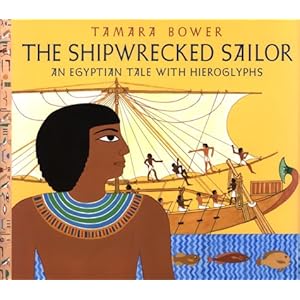
The Shipwrecked Sailor: An Egyptian Tale with Hieroglyphs is a beautifully illustrated tale retold from an ancient papyrus scroll believed to date to the nineteenth century B.C. I love that it is an authentic Egyptian story and not historical fiction. There's a place for both but the authentic literature is harder to come by for early ancient history, especially when considering what's appropriate for the younger student. Plus, there are actual hieroglyphic phrases in the illustrations of the book, complete with word-for-word pronunciation and translation!

Seeker of Knowledge: The Man Who Deciphered Egyptian Hieroglyphs is a wonderful picture book biography of Jean-François Champollion. It is well-written and nicely illustrated with lots of interesting information tucked in.

Adventures in Ancient Egypt, a time travel book written and illustrated in comic-book style, was fun for me to read, but I think I'll save reading it to Katherine until we cycle through again. It's appropriately designated for ages eight through twelve.
A City Through Time and A Street Through Time are both excellent pictorial overviews of the history of civilization from nomads through modern times. The detailed illustrations make these over-sized books lots of fun.


I think that's enough for now. Good night!

Saturday, September 8, 2012

Rest: The Opposite of Acedia

In reading Kathleen Norris's book, Acedia and Me: A Marriage, Monks, and a Writer's Life, I was cheered to come across the following passage on the nature of unceasing prayer:
We might well ask if these crazy monks don't have it coming: if your goal is to "pray without ceasing," aren't you asking for trouble? Is this a reasonable goal, or even a good one? Henri Nouwen tells us that "the literal translation of the words 'pray always' is 'come to rest.' The Greek word for rest," he adds, "is 'hesychia,' and 'hesychasm' is a term which refers to the spirituality of the desert." The "rest" that the monk is seeking is not an easy one, and as Nouwen writes, it "has little to do with the absence of conflict or pain. It is a rest in God in the midst of a very intense daily struggle."Acedia is the monk's temptation because, in a demanding life of prayer, it offers the ease of indifference. Yet I have come to believe that acedia can strike anyone whose work requires self-motivation and solitude, anyone who remains married 'for better for worse," anyone who is determined to stay true to a commitment that is sorely tested in everyday life. (p. 6)
Acedia definitely strikes me, and, for some reason, knowing that the cure is rest in God is so very comforting and encouraging. To pray always is to enter the height of creation, the Sabbath of worship and rest. It is to remember our freedom from bondage of every kind through our Savior. It is to enter into the re-creation, the Eighth Day of the resurrection. It is to be always present in the Kingdom of Heaven, hidden with Christ in God. By God's grace, may it always be the cry of my soul to be there in that hidden place.

Friday, August 17, 2012

Favorite Picture Books

We are always interested in captivating picture books around here, so I thought I'd share a few of our favorites from the last couple years. We borrow most of ours from the public library.

Jude and Katherine both love The Story of Noodles and Pond Walk. They urge me to re-request these from the library and never get tired of hearing them. As a bonus, each book comes with a recommended activity in the back. The Story of Noodles has a recipe, and Pond Walk has a craft. The Story of Noodles has changed the way we eat noodles in our family!


We also loved the books we've found on the various composers we've been studying. They are all excellent, Charlotte-Mason-quality "living books":


In January and February we discovered some great reads for Martin Luther King Jr. Day and Presidents Day. I got so carried away at the library that it kind of morphed into a mini-unit study on Lincoln, the Civil War, slavery, and the civil rights movement (with a little bit of George Washington and the War of Independence thrown in)! Here are just a few of the best reads:


This beautifully written book by Rosemary Wells is a chapter book rather than a picture book. Katherine, my kindergartener, and I read it together over several sittings and we were both engaged. However, she's a little young to fully appreciate it (and many kindergarteners probably wouldn't have the attention span to sit through it), so I'm saving this title for future reference. It's a very moving account of Abraham Lincoln through the perspective of his relationship with his two youngest sons, one of whom dies in childhood.

Henry's Freedom Box is a beautifully illustrated story of the amazing escape from slavery of Henry "Box" Brown. (His middle name tells his story!) This one was very frank about the horrors of slavery and was a bit too sad for my very sensitive girl to want to read more than once or twice. However, the copy I got from the library came with an audio CD containing read-aloud versions as well as a recording of a feet-stomping traditional African-American gospel song.

Words Set Me Free is the powerful story of how learning to read and write allowed Frederick Douglass to desire and eventually attain freedom from slavery. In addition to conveying an essential story in our country's history, it is the perfect story to read to an emerging reader and conveys the heart of what classically-informed educators mean by a "liberal education."

I love the story, the illustrations, and the layered message in Going Someplace Special. A pre-civil-rights girl finds a reprieve from the realities of racism in the public library where "All are welcome."

And here a couple other classic stories we've enjoyed recently:
 

Denham's lovely retelling of collected saint's lives is truly poetic at times. My favorite was the chapter on Saint Peter.


What are some of your favorite picture books?

Tuesday, August 7, 2012

Sanctification as Healing Through Inward Grace

I love the Orthodox understanding of sanctification and what it means to enter the Kingdom of God. I found the following quotation from Archbishop JOSEPH in Sunday's bulletin:
"We must strengthen ourselves by truly realizing that the God of the Universe is the God who dwells within us. When we begin to enter into our interior universe, we will find how close we are to our healing. God has given us all things, we need only remove from our inner selves what is not of God."

When I poked around the internet, I found that his words were taken from an address he gave in 2005 at the Northern California Ladies Retreat. I love it so much I am copying all but the introductory remarks below.

[. . .] When we speak of illness, we often think of symptoms: a cough, a pain, a discoloration. Yet, these are only signs that an illness has already taken hold of our bodies. An illness runs deeper than the symptoms, and it is only through careful examination that a physician can discover an illness before the symptoms develop.

This is true of both the body and the soul. Our souls and minds can become infected with very real and very deadly diseases, which result in a variety of symptoms. St. Paul refers to them as works of the flesh. In Galatians, he wrote:
"Now the works of the flesh are plain: fornication, impurity, licentiousness, idolatry, sorcery, enmity, strife, jealousy, anger, selfishness, dissension, party spirit, envy, drunkenness, carousing, and the like. I warn you, as I warned you before, that those who do such things shall not inherit the kingdom of God." (Gal 5:19-21)
The Holy Apostle warns us that symptoms indicate that the disease of sin is so great that we cannot enter the Heavenly Kingdom. Just as an unhealthy body prevents us from going places, so an unhealthy soul prevents us from going into spiritual places, foremost of which is the Kingdom of God.

Let us also remember our Lord’s words recorded in the Gospel:
“For which is easier, to say, ‘Your sins are forgiven,’ or to say, ‘Rise and walk’? But that you may know that the Son of man has authority on earth to forgive sins" -- he then said to the paralytic – “Rise, take up your bed and go home.” (Mt 9:5-6)
Sin is a greater affliction to man. Though physical sickness may cause us great suffering, sin keeps us removed from God’s presence and sets in a place of eternal suffering. Physical wellness is of no value to a suffering soul, wracked with a guilty conscience and angry unforgiveness. Our Lord offers us forgiveness first, that might be healed of soul, so that we can join in the Mystical Union of Christ and the Church. 

If we are to enter into the Bridal Chamber, we must be healthy. The diseases that afflict us must be cured. From the example of the saints, we know that physical diseases afflicted people close to God. Yet, we also know that many diseases are brought about by what we now call ‘lifestyle decisions.’ The alcoholic suffers from the disease of cirrhosis brought about by his drinking, and the coal miner suffers from black lung because he worked too long in the mines.

Therefore, to live a peaceful and joyous life, we must be mindful of how we live. We must have a ‘healthy lifestyle.’ We listen to the advice of doctors in caring for our bodies, and we should listen to the teachings of the Church if we desire to have a healthy soul.

However, I know that many of you are coming here to this retreat with much suffering. You are in pain and seeking healing. I promise that what you hear this weekend can be, for all of you, a new beginning on the road to healing. What I hope all of you will find here is hope, a hope and faith in our Lord, Jesus Christ, which will give you the strength to change. For the solution to all illness is found in our willingness to take the cure. The sick person who refuses the medicine will not receive its benefits, and those who reject the teachings of the Church also reject the cure of the soul which the Church offers.

For some of you, this will be a long road. My hope is that the friendships you build here will become a means of support as you journey along the way. It may be difficult to return from here to places we know are sick. Perhaps we do not think that our homes or parishes are healthy places. Never forget that the medicine is always stronger than the disease, and that your own healing will heal all those around you. You do not need to rely on the spiritual health of others to be healthy yourselves. Our Holy Faith has survived centuries in the hearts of people surrounded by those who hated them. We must strengthen ourselves by truly realizing that the God of the Universe is the God who dwells within us. When we begin to enter into our interior universe, we will find how close we are to our healing. God has given us all things, we need only remove from our inner selves what is not of God.

I hope that all of you find in this retreat a renewed confidence in our Lord, Jesus Christ. Never forget the inseparable bond we have in the Church, and let us aid one another in this marvelous journey in the Kingdom of Heaven.

Sunday, July 29, 2012

God Himself

On my kitchen counter stands a four-by-four-inch mahogany-stained wooden frame suspended in a wrought iron stand. Both the wood and glass are speckled faintly with water spots and dust. Ornamenting the frame's face, a small pressed wild flower has been lacquered on with clear nail polish. The tiny petals are almost as faint as the water marks against the backdrop of wood. Behind the glass, the frame encloses a handwritten inscription transcribed more than a dozen years ago, the immaculate lyric script undeniably my friend Amanda's.

She made the framed quotation as a present for me in college in a season when I began to feel my first real doubts about my Christian faith. In a wave—no a sea—of fear and insecurity, I realized I couldn't just believe that God, if he existed, loved me. It made no sense. My mind spun trying to fathom how a God could love everyone—so many billions upon billions of us—and even more how he could truly love any one of us, for example, myself—as incredibly unlovable as I found myself to be.

The words in the frame spoke to me in that place. They are words attributed to Madeline L'Engle, but I believe L'Engle got them from Miguel de Unamum (see Treatise on Love of God, p. 15). Here they are, arranged to match as closely as I can Amanda's poetic turning of them: 

"They who believe
            they believe in God,
but without passion in the heart
        without anguish of mind,
without uncertainty,
                      without doubt,
        and even at times
                         without despair,
believe only in the idea of God,
        and not in God himself."

God himself. He is a self, a person, not a proposition. My mind still whirls when I try to understand how he could possibly exist, possibly love, possibly act in my life. I get dizzy like Annie Dillard at the vastness of the universe and want to lie down on something low and solid, to feel some containment, something palpably sure and secure.

I don't think the fear and doubt will ever go away in this lifetime, but I have more or less learned to sit with them. I let them wash over me as they come and go like waves, knowing that I do not sit with them alone. The same one who sits with me once stood suspended faint against the wood, against the dark. On him my hands are clasped like the dead waiting for resurrection. He is my only light.